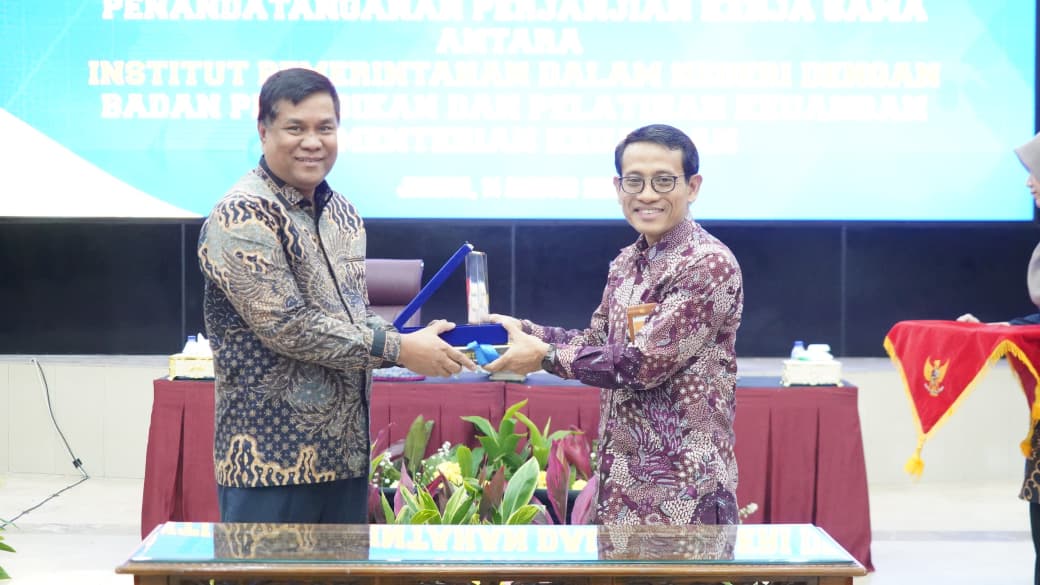
IPDN Collaborates with the Financial Education and Training Agency (BPPK)
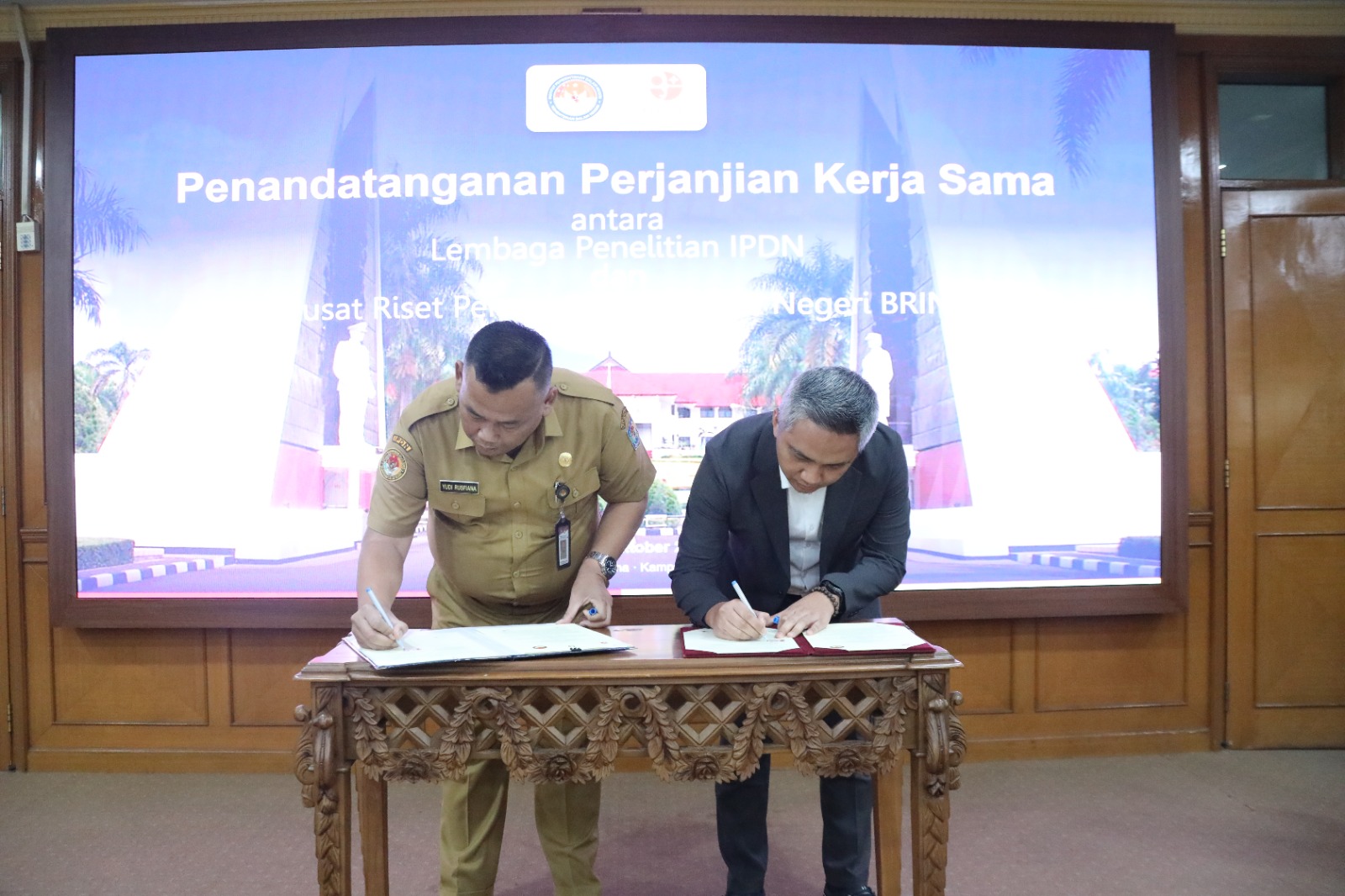
Today, at the Zamhier Islamie Hall, IPDN Jakarta Campus, a Cooperation Agreement (PKS) was signed between the Institute for Domestic Government (IPDN), Ministry of Home Affairs and the Financial Education and Training Agency (BPPK), Ministry of Finance. The signing of the PKS was carried out by Halilul Khairi, Chancellor of IPDN and Sudarto, Plt. Head of BPPK. This activity was also attended by leadership from IPDN and BPPK.
This PKS signing activity is a follow-up to the strategic partnership between IPDN and BPPK, as well as a follow-up to the Memorandum of Understanding between the Ministry of Home Affairs and the Ministry of Finance, in order to prepare and improve the competency of government agency human resources in providing higher quality services that can be felt directly by the service user community. The services provided by civil servants with IPDN graduates are spread throughout Indonesia and cover various sectors of public interest.
The theme raised in this PKS is Synergy in the Implementation of Education, Training, Competency Certification and Studies in the Field of Domestic Government and in the Field of State Finance. By synergizing knowledge in the field of state finance and technical competence in the field of domestic government, especially competence related to regional finance, it is hoped that we will be able to provide impactful services to society that are more transparent, accountable and trustworthy.
In his speech, Plt. The Head of BPPK expressed his appreciation for the cooperation between IPDN and BPPK. The strategic role of state finances requires competent human resources (HR) management. BPPK realizes that collaboration with various government units, especially on this occasion with IPDN, is really needed to disseminate state financial management capabilities. The need for human resources for managing state/regional finances is also always a concern of leaders at a higher level (DPR). BPPK is also ready to implement collaborative cooperation between IPDN campuses in the regions and the Financial Education and Training Center (BDK) as the BPPK unit in the regions. It was further stated that the forms of cooperation that will be implemented include education, training, certification and joint studies in the field of state finance. BPPK is ready to carry out this collaboration to achieve the expected outcome, namely better management of state/regional finances so that it can maintain fiscal and monetary stability at the central and regional levels.
In his speech, the Chancellor of IPDN said that this collaboration is expected to bring benefits at two strategic levels. First, at the policy level, with the direction of IPDN as the center of excellence for the Ministry of Home Affairs, IPDN is required to increasingly make studies in the field of domestic government which intersect with state financial management as a basis for consideration of the policy making process. Second, IPDN also plans to improve the English language skills of students to increase their ability to compete in studying abroad. The basic reason for the aim of overseas education itself is culture, network and knowledge factors that are different from those at home. These three factors are expected to strengthen capabilities
Source: BPPK Kemenkeu
Back to News