MenpanRB and DPN Ministry of Defense Provide Insight into the Development of Bureaucratic Reform and the National Resilience System to Praja Utama
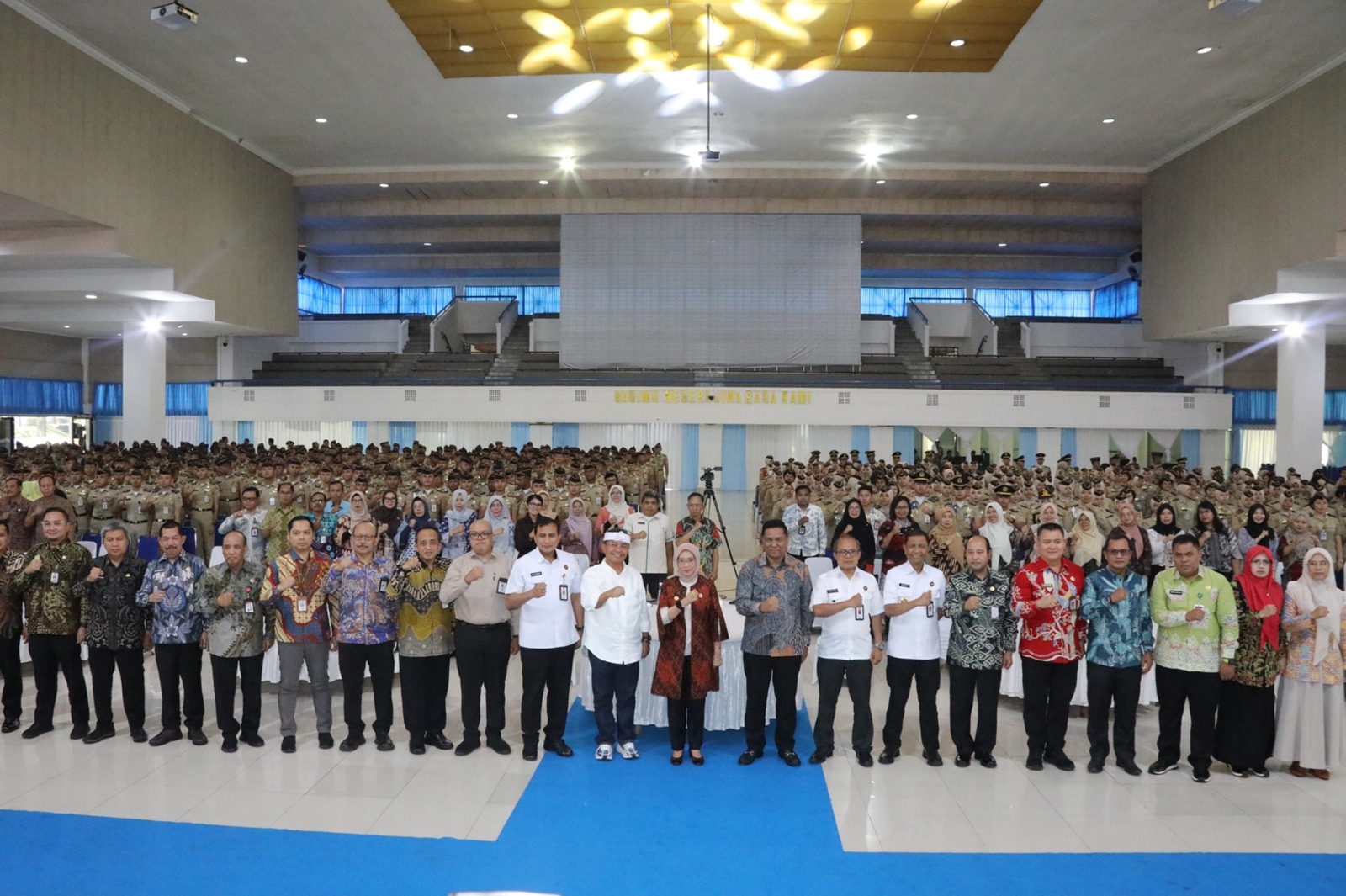
Jatinangor (16/04/2026) – Praja was introduced to a new face of public service bureaucracy, namely Human Based Service. This understanding was delivered directly in front of 1,216 civil servants by the Minister of State Apparatus Empowerment and Bureaucratic Reform of the Republic of Indonesia, Rini Widyantini., S.H., MPM during _general stadium_ activities at Balairung Rudini Building, IPDN Jatinangor Campus. IPDN Chancellor, Dr. Halilul Khairi., M.Si said that this activity was carried out in the context of providing training for the main praja or prospective IPDN graduates and female graduates in 2026. "Before going directly, serving in the region as State Civil Apparatus, IPDN praja who will graduate must get the latest information regarding developments in bureaucratic reform," he said. According to him, knowing and understanding the urgency of bureaucratic reform is not just an administrative obligation for an ASN but rather a direction, amidst increasingly high public demands.
Apart from the presentation from the MenpanRB, this general stadium activity was also attended by the Deputy for Geostrategy of the National Defense Council (DPN) of the Ministry of Defense, Major General TNI Ari Yulianto., S.I.R., M.H.I. "In addition to understanding bureaucratic reform which will become the daily bread of ASN candidates, things related to national resilience are also very important for civil servants to know in this era of globalization which is full of disruption. National resilience is a navigation system for them to remain standing in the midst of ideological, economic storms and global threats that they will face," said Halilul. MenpanRB conveyed that regarding the challenges of today's IPDN generation, one of them is that they will lead in a rapidly changing world. "If you look back, change has always existed and the bureaucracy continues to adapt, but the rhythm of change today is different. Change comes much more quickly while technology develops rapidly and people's expectations continue to increase.
"In the future, challenges will come together, AI, service integration, data security and fast-paced demands require the government to remain responsive but also fair, transparent and accountable," he said. Not only that, according to him, the crisis of public trust is also a challenge for global bureaucracy. "Public trust can be achieved one way by implementing human-based public services. A new face of bureaucratic reform that is warmer, more responsive and empathetic. "The civil servants must be able to create a bureaucracy that has a heart, seeing society as human beings who have urgent needs and feelings," he said again. In preparing themselves as ASN who can contribute to bureaucratic reform more effectively and efficiently, the Minister of Administrative and Bureaucratic Reform stressed to the civil servants to learn important things before they are deployed directly in society, "The important things that you must learn and strengthen are digital competence, speaking based on data, mastery of AI, cloud and cybersecurity as well as accelerating technological adaptation in the bureaucracy," he said.
Another thing conveyed by Major General Ari, he provided an understanding regarding several potential divisions that exist in Indonesia. "You will be directly involved in society, placed from Sabang to Merauke. It is possible that you will be placed in conflict areas, which is why you must understand and uphold the principle that unity and tolerance are valuable legacies of the nation's founders which must be maintained," he said. Major General Ari emphasized that civil servants as candidates for state civil servants must understand issues related to divisions that exist in Indonesia, "Ethnic, racial, religious divisions, social and economic and political inequality such as the Sampit tragedy, tribal conflict in Papua, GAM and OPM, Ambon conflict, oligarchy, capitalism, polarization, slander and tests of hatred must all be studied and understood so that later you can contribute to minimizing or even preventing potential divisions," he appealed. According to him, this state defense system is universal, that is, it involves all citizens, regions and other financial resources which are prepared early and implemented in a total, directed and continuous manner. "The state needs civil servants to be able to support this defense system. Of course, civil servants are equipped with the characteristics of tanggon, namely having a nationalist spirit and good character which is supported by the ability to respond and be strategic," he said. At the end of his presentation, Major General Ari asked civil servants to maintain communication, use social media well, and not participate in spreading fake news which could ultimately cause division in the nation.
Source: Kepala Bagian Hubungan Masyarakat
Back to News