IPDN Provides Understanding of the Importance of Morals and Knowledge of Kings in the Digital Governance Era
Jatinangor (07/05/2026). Committed to producing clean and anti-corruption bureaucrats, IPDN is taking preventive steps by providing training on "Clean Governance in the Digital Governance Era" to the main candidates for 2026 graduates.
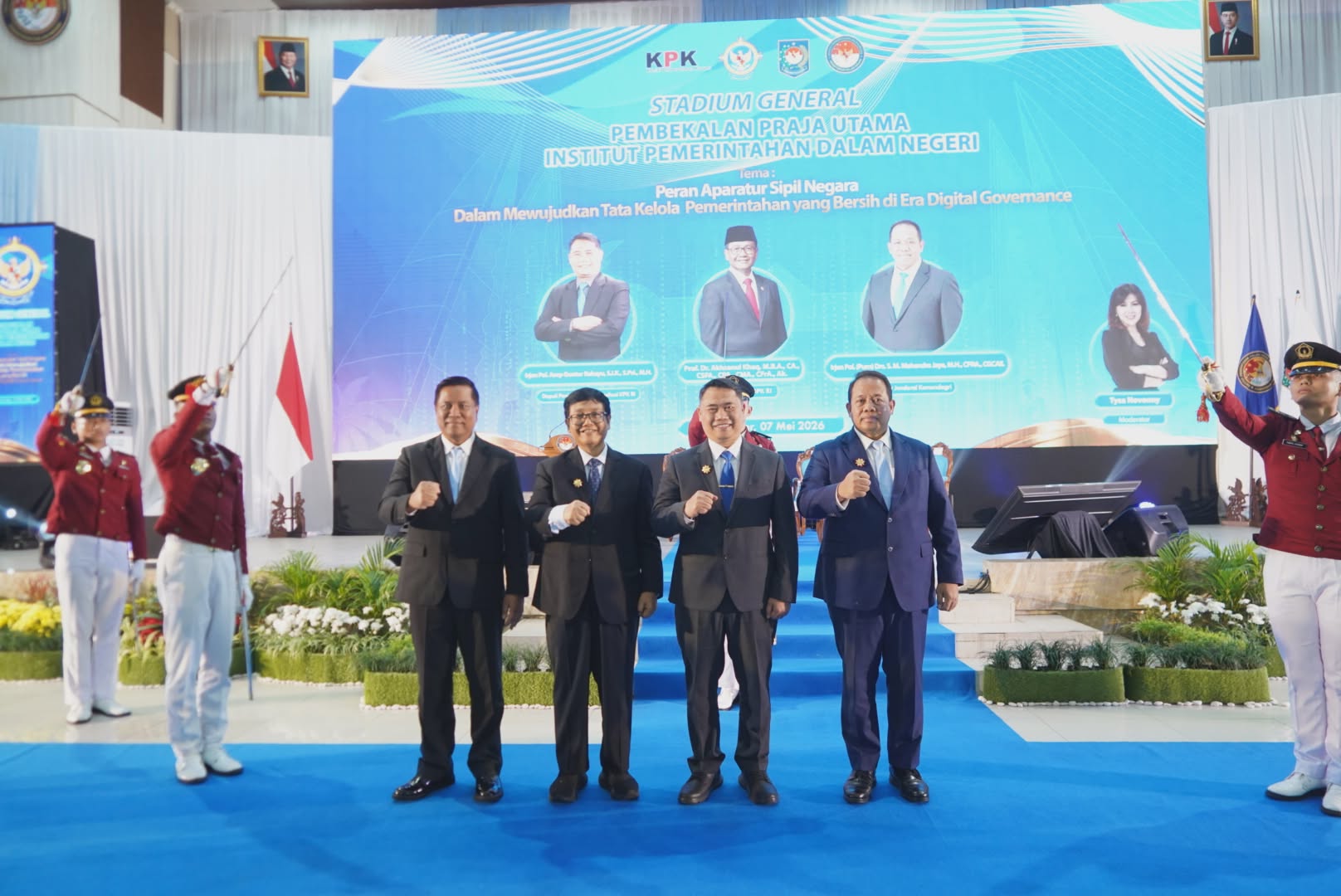
IPDN Chancellor, Dr. Halilul Khairi., M.Si presented 3 competent speakers in this activity, namely Inspector General of Police. Asep Guntur Rahayu., S.I.K., S.Psi., M.H (Deputy for Enforcement and Execution of the Indonesian Corruption Eradication Committee), Prof. Dr. Akhsanul Khaq., M.B.A., CA., CSFA (Member III BPK RI) and Inspector General of Police. (Ret.) Drs. Sang Made Mahendra Jaya., M.H (Inspector General of the Ministry of Home Affairs).
"The challenge of maintaining bureaucratic integrity in this era of digitalization is of course very difficult. We must equip these ASN candidates with a moral foundation and knowledge about clean government governance as early as possible, so that after graduating from IPDN they will grow into officials with integrity, adaptability, resilience, competitiveness and can run the government transparently and accountably," said Halilul.
In his material, Inspector General Pol. Asep Guntur Rahayu emphasized to IPDN officers to be careful and stay away from acts of corruption when they enter society as ASN. "In the period from 2004 to 2026 alone, there were 544 corruption cases involving Ministries/Institutions. 220 cases occurred at the Provincial Government level, 669 at the Regency/City Government level, 205 cases at BUMN/BUMD, 28 cases at the Commission, and 90 cases at the DPR RI. This should be a reminder for you to be careful in navigating bureaucracy," he said. According to him, there are at least 3 types of corruption that often ensnare regional heads, namely gratification, bribery and extortion. In dealing with these acts of corruption, the Corruption Eradication Committee has a corruption eradication strategy called TRISULA: Education, Prevention and Action. The principle of education is related to instilling anti-corruption values, the principle of prevention is to improve the system and the principle of action is the deterrent effect. And the most important thing is public participation as social control so that acts of corruption will be discovered with the help of reports from the public. "So, for the civil servants who will later become bureaucrat candidates, I emphasize that they must understand the existing rules in government, and implement these rules according to the corridors, so that later they will not be caught in corruption cases," said Inspector General Pol Asep at the end of his material.
This is different from Inspector General Pol Asep who stated acts of corruption. Inspector General of Police. (Ret.) Drs. Sang Made Mahendra Jaya., M.H provided insight regarding the governance problems that IPDN officers will face in the field. "Systematic corruption, system fragmentation and digital without transformation are governance problems in Indonesia. Systematic corruption occurs because of a weak system including procedural gaps, weak internal control, deviant practices that are considered normal and a permissive culture. This causes good individuals to be trapped because the existing system does not prevent it, the environment does not reject it and supervision is ineffective," he said. He also explained that many government systems and applications have data that is not synchronized, there is data manipulation and duplication of data input. In fact, this makes it difficult for individuals to make data-based decisions, so that policies are not on target and supervision is not optimal. "The condition of digitalization without transformation also means that bureaucracy continues to run for a long time, deviations still occur, it's just that the methods are different," he said. At the end of his material, Inspector General of Police (ret.) Sang Made Mahendra reminded civil servants to have integrity as the main foundation for acting correctly even without supervision, to have competence, namely adaptive intelligence to technological changes and moral courage, namely the courage to reject interventions that do not comply with the rules.
Meanwhile, member III of BPK RI, Prof. Akhsanul, highlighted the dynamics of a world full of turmoil, uncertainty, complexity and ambiguity or what is known as VUCA. "The government is implementing the SUPER strategy (Synergy, Excellence, Professionalism, Empathy and Rampak). This strategy is the foundation for the state apparatus to remain relevant and effective. Technology integration through digitalization instruments is seen as the main solution in implementing these values in the field," he said. However, according to him, this digitalization era is not without obstacles, the Government has identified five big challenges, namely inequality between regions, data quality, cyber security & data protection, adaptation of Artificial Intelligence (AI), as well as aspects of human resource integrity. "To be able to survive and overcome these obstacles, you IPDN officers who are prospective state civil servants or bureaucrats must master the 4 pillars of digital literacy, namely digital skills, digital ethics, digital culture and digital safety," he said.
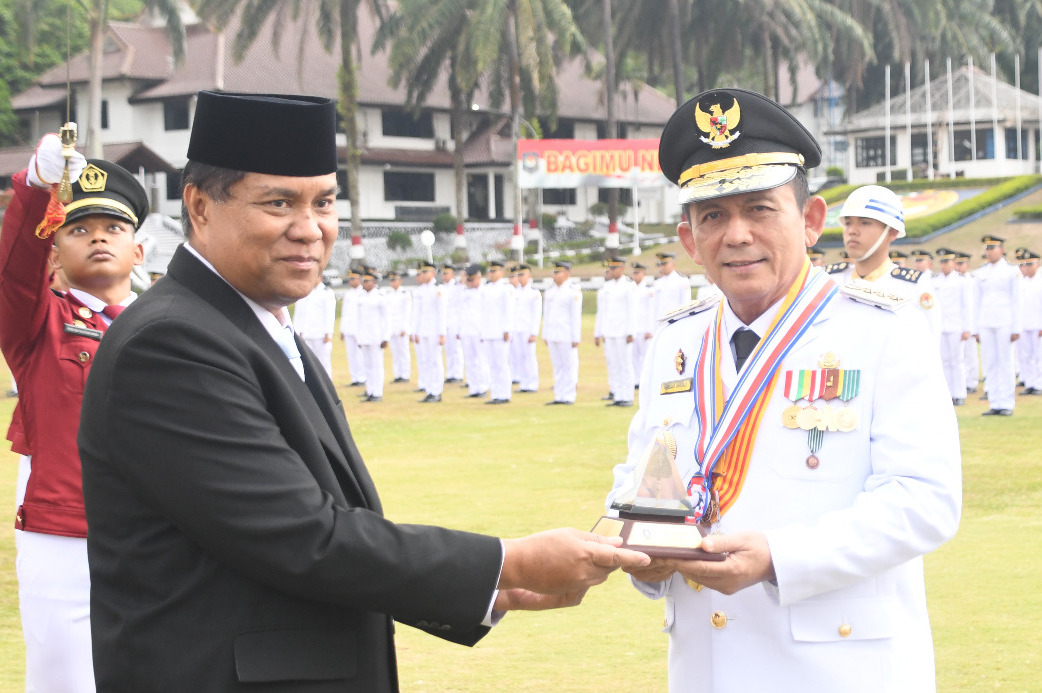
On this occasion, IPDN is also proud to award the three speakers with Honorary Alumni today. "This award is given as a form of IPDN's respect and appreciation for the contribution, support and dedication of the three resource persons who have achievements in the field of government and also contributed in the field of education at IPDN," said the Chancellor of IPDN. According to him, Prof. Akhsanul has made a strategic contribution in encouraging the strengthening of accountable governance as part of developing government cadres within IPDN. Meanwhile Inspector General of Police. Asep provides full support for strengthening anti-corruption education and building a culture of integrity for government cadres within IPDN. Likewise with Inspector General of Police (Ret.) Sang Made Mahendra, he contributed and was fully committed to strengthening supervision and assistance in the implementation of the Praja Candidate Admission Selection for the past 3 years.
Source: Kepala Bagian Hubungan Masyarakat
La Ode Muhamad Alam Jaya., S.STP., M.Si.
Back to News