Praja IPDN Continues to Carry Out Praja Work Service and Real Work Lectures in Their Respective Areas of Origin
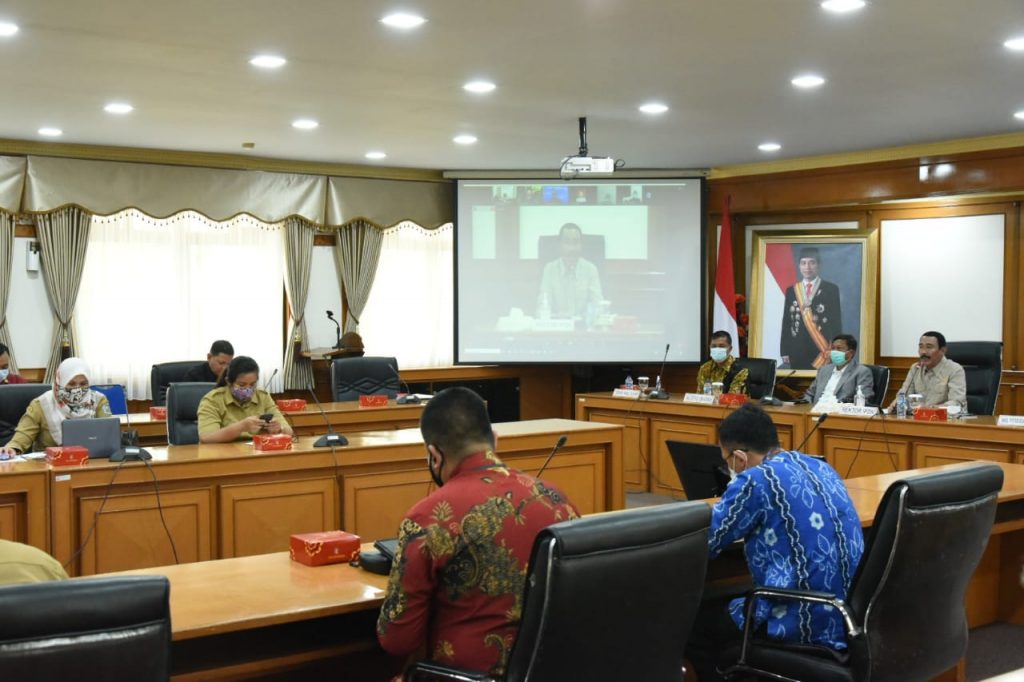
Jatinangor, Monday (22/02/2021). A total of 1,534 principal officers from the Institute for Internal Government (IPDN) continue to carry out Bhakti Karya Praja (BKP) and Real Work Lectures (Kukerta) in their respective regions of origin. This was conveyed directly by the Chancellor of IPDN, Dr. Hadi Prabowo, M.M when opening the implementation of BKP and Kukerta online via the IPDN Public Relations YouTube channel. The implementation of BKP and Kukerta will be carried out from today, namely February 22 2021 to March 19 2021 in the area of origin of each municipality, this is due to the Covid-19 pandemic situation which is still hitting Indonesia. The main praja who implemented the BKP were the main praja from the Applied Bachelor's program (D-IV) with a total of 1,386 people, while the main praja who carried out the Kukerta were the main praja from the Bachelor (S-1) program with a total of 148 people. BKP and Kukerta are field practice activities that must be carried out by IPDN students as a form of implementation of the Tri Dharma of Higher Education.
"Due to the Covid-19 pandemic which is still hitting Indonesia, this activity is carried out in each praja's home area. So later the main praja will go directly to the field, to the OPD in their home district or city to see directly the conditions of their respective regions, what problems are currently occurring in that area in an actual and factual way. They must identify the problems that occur in the field, formulate the problem and of course analyze the problem. Until then, the praja is expected to be able to provide input or alternative solutions to the problems that occur," said the IPDN Chancellor. In implementing BKP and Kukerta, IPDN students will analyze a problem according to the study program they study on campus. In the process, students are still guided directly by their respective supervisors, even though the implementation is carried out online. The IPDN Chancellor reiterated the health protocols that prajas still have to apply when starting activities, "I hope that during the implementation of the BPK and Kukerta, prajas still have to comply with the Covid-19 health protocols, don't forget to apply the 3 M's when going into the field," he said. Not only related to raising problems in the field of government science, IPDN prajas are also expected to be able to raise local wisdom in their respective regions and be able to convey policies or information conveyed by the Ministry of Home Affairs to village officials or the community in the area. "Issues that can be touched upon within the scope of government, for example the process of obtaining an E-KTP, NIP and Birth Certificate, whether the process is optimal or not, then whether the local OPD has used an application that can make this process easier and so on. Apart from exploring existing problems, the praja is also expected to be able to become a bridge between the Ministry of Home Affairs and regional apparatus or even the community there. So, the praja may later be able to convey actual information or data related to Ministry of Home Affairs products, one example of which is 49 Regulations "Government in the Job Creation Law," said the Chancellor of IPDN. According to the Chancellor, IPDN is an institution that seeks to produce civil service cadres, this is in accordance with its vision, namely "to become a trusted civil service higher education in producing competent government cadres, with character and personality", to be able to achieve this vision in BKP and Kukerta Praja activities, IPDN must be able to understand the theory obtained on campus, see and observe the situation that occurs in the regions, what problems exist and be able to realize development synergy between the central government and regional governments.
"Due to the Covid-19 pandemic which is still hitting Indonesia, this activity is carried out in each praja's home area. So later the main praja will go directly to the field, to the OPD in their home district or city to see directly the conditions of their respective regions, what problems are currently occurring in that area in an actual and factual way. They must identify the problems that occur in the field, formulate the problem and of course analyze the problem. Until then, the praja is expected to be able to provide input or alternative solutions to the problems that occur," said the IPDN Chancellor. In implementing BKP and Kukerta, IPDN students will analyze a problem according to the study program they study on campus. In the process, students are still guided directly by their respective supervisors, even though the implementation is carried out online. The IPDN Chancellor reiterated the health protocols that prajas still have to apply when starting activities, "I hope that during the implementation of the BPK and Kukerta, prajas still have to comply with the Covid-19 health protocols, don't forget to apply the 3 M's when going into the field," he said. Not only related to raising problems in the field of government science, IPDN prajas are also expected to be able to raise local wisdom in their respective regions and be able to convey policies or information conveyed by the Ministry of Home Affairs to village officials or the community in the area. "Issues that can be touched upon within the scope of government, for example the process of obtaining an E-KTP, NIP and Birth Certificate, whether the process is optimal or not, then whether the local OPD has used an application that can make this process easier and so on. Apart from exploring existing problems, the praja is also expected to be able to become a bridge between the Ministry of Home Affairs and regional apparatus or even the community there. So, the praja may later be able to convey actual information or data related to Ministry of Home Affairs products, one example of which is 49 Regulations "Government in the Job Creation Law," said the Chancellor of IPDN. According to the Chancellor, IPDN is an institution that seeks to produce civil service cadres, this is in accordance with its vision, namely "to become a trusted civil service higher education in producing competent government cadres, with character and personality", to be able to achieve this vision in BKP and Kukerta Praja activities, IPDN must be able to understand the theory obtained on campus, see and observe the situation that occurs in the regions, what problems exist and be able to realize development synergy between the central government and regional governments.
Source: Humas IPDN
Back to News