IPDN Holds National Seminar Regarding Special Autonomy for Papua and West Papua in the 65th IPDN Anniversary Series
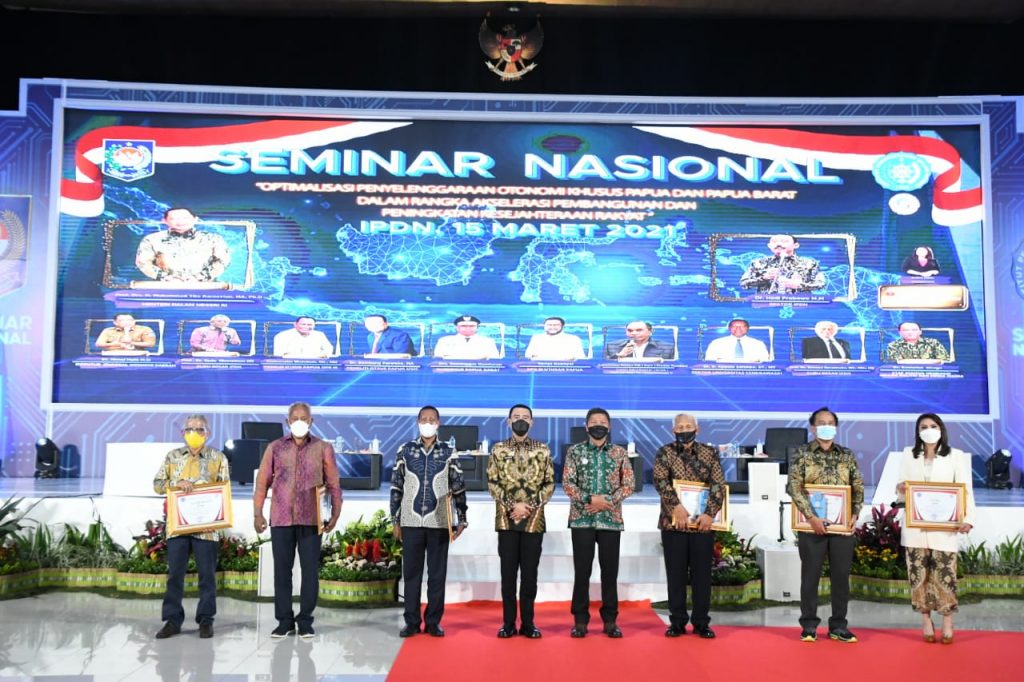
Jatinangor, Monday (15/03/2021) Secretary General of the Ministry of Home Affairs of the Republic of Indonesia Dr. Ir. Muhammad Hudori, M.Si representing the Minister of Home Affairs of the Republic of Indonesia acted as the keynote speaker as well as opening the national seminar with the theme "Optimizing the Implementation of Special Autonomy for Papua and West Papua in the Context of Accelerating Development and Improving People's Welfare". Apart from the Secretary General of the Ministry of Home Affairs, the Chancellor of IPDN, Dr. Hadi Prabowo accompanied by IPDN leadership also attended and took part in this event. This seminar event is one of a series of events in the framework of the 65th IPDN anniversary which falls on Wednesday, March 17 2021. IPDN will hold its 65th anniversary with the theme "Improving the Quality of Education through Innovation to Create Competitiveness in the Midst of the Covid-19 Pandemic". The entire series of IPDN anniversary events were held internally, limited by implementing very strict Covid-19 health protocols.
This national seminar is held offline and online via the zoom meeting application and can also be watched streaming via IPDN Public Relations YouTube. The number of participants in this national seminar reached 10,492 people. The implementation of this national seminar received appreciation from MURI with the awarding of a certificate of appreciation to IPDN for having the most participants in implementing the webinar on optimizing the special autonomy of the Provinces of Papua and West Papua. Apart from the Minister of Home Affairs and the Chancellor of IPDN, the national seminar hosted by Aviani Malik as moderator of this event, invited several competent speakers such as the Director General of Regional Autonomy at the Ministry of Home Affairs, Dr. Akmal Malik, M.Si, Special Staff to the Ministry of Home Affairs Dr. Kastorius Sinaga, Special Autonomy Committee for Papua DPR RI Komarudin Watubun, S.H., M.H, Member of DPD-RI Yorrys Raweyai, Governor of West Papua Province Drs. Dodunias Mandacan, represented by the Special Autonomy Bureau Fitalis Yumte, Papuan Community Leader/Former Indonesian Minister of Transportation Laksdya. TNI (Ret.) Freddy Numberi, Papua Special Autonomy Researcher from Gajah Mada University Dr. Bambang Purwoko, M.A, Chancellor of Cendrawasih University Dr. Ir. Apolo Safanpo, S.T., M.T and IPDN Professor namely Prof. Dr. Ermaya Suradinata, S.H., M.H., M.S and Prof. Dr. Sadu Wasistiono, M.S. "Even though the situation and conditions in the country are still unstable due to the Covid-19 pandemic, we are sure that this is not a reason to continue to excel and provide the best for the nation and state of Indonesia. IPDN at the age of 65 will continue to be dedicated to providing community service with superior innovations. One of them is by holding this national seminar, this is also a form of implementing the Tri Dharma of Higher Education, especially in the aspect of community service," said the Chancellor of IPDN. According to the Chancellor of IPDN, the focus of this national seminar is identifying problems in the implementation of special autonomy for Papua and West Papua, carrying out critical analysis of strategic problems in implementing policies for implementing special autonomy for Papua and West Papua in accelerating development and people's welfare. "We hope that with this seminar, we can formulate effective formulas and strategies related to accelerating development and increasing people's welfare in Papua and West Papua and produce policy recommendations as input for the formulation of the draft Law on Special Autonomy for Papua which is oriented towards optimizing the implementation of special autonomy for Papua and West Papua," he said.
The Secretary General of the Ministry of Home Affairs said that the keyword for this special autonomy issue is the existence of a strong and consistent national commitment from all parties to implement this special autonomy. "The hope is that this seminar can provide constructive formulations to improve the development and welfare of the people of Papua and West Papua in the future," said the Secretary General of the Ministry of Home Affairs. Meanwhile, the Director General of Special Autonomy, Ministry of Home Affairs, provided clarification regarding the issues circulating regarding the end of the special autonomy for Papua and West Papua, "What ends in November 2021 is the support for special autonomy funds, not special autonomy. In this case, all parties, both central and regional/local, play a role in special autonomy, so it is not just a problem for the Ministry of Home Affairs. The Ministry of Home Affairs carries out guidance, supervision, monitoring and evaluation, then we hope that our friends at the local level can implement it directly," said Akmal. The DPR RI Special Autonomy Special Committee for Papua, Komarudin Watubun, S.H., M.H, gave suggestions for conducting evaluations related to special autonomy in a comprehensive and dignified manner, "Perhaps a consortium could be created led by the university rector, to evaluate special autonomy as a whole by involving all parties. Because the problem of special autonomy is not just funding, weak human resources at the local leadership level, weak transparency in implementation are also problems that must be considered," he said. The problem related to the absence of a special institution/service that takes care of indigenous Papuan people or communities was a problem raised by Fitalis Yumte (Papua Special Autonomy Bureau), "the central government's attitude must be clear in regulating the authority of Papuans, there must be an institution that focuses on dealing with special autonomy issues," he said. Several other speakers also conveyed their suggestions and input regarding optimizing the implementation of special autonomy for Papua and West Papua at this seminar. At the end of the event Dr. Drs. H. Ismail Nurdin, M.Si as chairman of the event committee presented the results of the formulation of this national seminar.
Source: Kepala Bagian Kerja Sama dan Humas IPDN
Ervin Fahlevi, S.Sos., M.M
Back to News